Understanding cancer statistics is crucial for comprehending the burden of this disease in Canada. These statistics provide valuable insights into the number of individuals diagnosed with and succumbing to cancer annually. They illuminate trends in new cancer cases and cancer-related deaths, offering a comprehensive overview of cancer’s impact on Canadians.
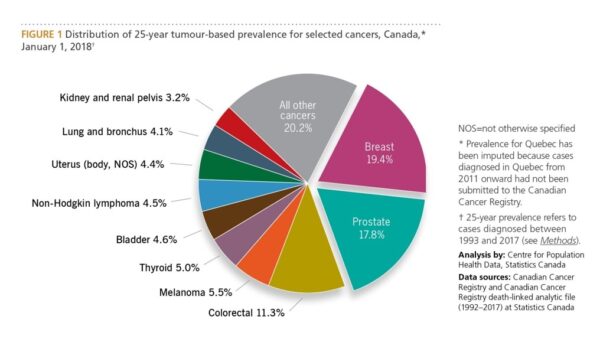
Canadian provinces and territories diligently collect data on cancer cases and deaths. This data is meticulously compiled to paint a national picture of cancer prevalence and its consequences across the country. Cancer statistics play a pivotal role in healthcare planning by informing resource allocation and policy decisions. Furthermore, they serve as a critical tool for evaluating the effectiveness of cancer care and control initiatives.
This resource offers a glimpse into key cancer statistics, encompassing incidence and mortality rates categorized by sex, age group, and geographic region. It’s important to note that these statistics are presented based on sex assigned at birth, aligning with the standards used by Statistics Canada. The dataset includes an undisclosed number of individuals identifying as intersex, transgender, non-binary, or gender-diverse, as data specific to gender identity was unavailable.
Incidence refers to the number of newly diagnosed cancer cases, while mortality represents the number of deaths caused by cancer.
To determine the estimated number of new cancer cases and deaths for a given year, researchers rely on the latest available data and advanced statistical methodologies. Based on these analyses, researchers projected that in 2024, Canada would experience approximately 247,100 new cancer cases and 88,100 cancer-related deaths. It is crucial to note that this estimate excludes non-melanoma skin cancer cases.
On average, it is estimated that 675 individuals in Canada would be diagnosed with cancer and 241 individuals would succumb to cancer each day in 2024.
Cancer incidence for males and females in Canada in 2024
In 2024, an estimated 127,100 males and 120,000 females were projected to receive a cancer diagnosis. Prostate cancer was anticipated to comprise roughly 22% of all new cancer cases in males. Breast cancer was expected to account for 25% of all new cancer cases in females. Lung and bronchus (lung) cancer was projected to be the second most prevalent cancer in both males (following prostate) and females (after breast). A greater number of females (17,300) than males (14,800) were projected to be diagnosed with lung cancer.
Users can leverage the interactive graphs and maps that follow to delve deeper into cancer statistics. These resources encompass additional statistics related to specific cancer types and statistics for males, females, or both sexes combined. For certain interactive graphs, users can access statistics for various age groups. Feel free to explore the diverse filters available to access the statistics.
Distribution of Projected Cancer Cases in Canada, 2024
The interactive graph visualizes the projected distribution of cancer deaths among males and females in 2024. Based on statistical estimations, it is anticipated that in 2024, 47,300 males and 40,800 females will succumb to cancer.
Lung cancer is predicted to be the primary cause of cancer-related fatalities in both males (10,900 deaths) and females (9,800 deaths). This malignancy is projected to be responsible for approximately one-quarter of all cancer deaths.
Cancer is a serious health concern that can affect individuals of all ages. However, the likelihood of developing cancer significantly increases with age.
Statistics from Canada reveal that a staggering 9 out of 10 cancer diagnoses occur in individuals over the age of 50. To provide a deeper understanding of cancer trends, interactive graphs present data on the percentage of cancer cases and deaths across various age groups from 2017 to 2019.
These visualizations allow users to explore cancer incidence and mortality rates by age group. Analysis of the provided graph indicates that the highest proportion of newly diagnosed cancer cases was observed in the 65 to 74 age range. Notably, within the 15 to 59 age bracket, females exhibited higher cancer rates compared to males.
Furthermore, the graph clearly demonstrates a sharp increase in both the number of cancer deaths and mortality rates as age advances.
The accompanying maps depict the projected distribution of cancer cases and fatalities nationwide in Canada during the year 2024.
Estimates for 2024 indicate that cancer incidence rates are anticipated to be highest in eastern and central Canada.
Mortality rates for all cancer types combined are projected to be generally higher in the East and lower in the West.
Variations exist across Canada for specific types of cancer. It is estimated that:
Colorectal cancer incidence and mortality rates are projected to be highest in Newfoundland and Labrador for both males and females.
Lung cancer incidence and mortality rates are generally anticipated to be highest in Quebec and the Atlantic provinces.
Variations in cancer incidence rates among provinces and territories can be attributed to differences in risk factors (including behaviors and exposures), diagnostic practices, and data collection methodologies. Similarly, cancer mortality rates fluctuate due to regional variations in incidence. Mortality rates may also differ because of disparities in access to and outcomes of cancer services, such as screening, diagnosis, treatment, and follow-up.
Understanding cancer survival statistics is crucial for patients, families, and healthcare professionals.
One method of measurement is net survival, which estimates the percentage of individuals alive after a cancer diagnosis, factoring in deaths from other causes. Most survival rates are reported over a specific timeframe, typically five years.
According to data from 2015 to 2017, the projected five-year net survival rate for all cancers combined was 64%. This indicates that approximately 64% of individuals are anticipated to survive at least five years following a cancer diagnosis. This represents a notable increase from 55% in the early 1990s and significantly higher than the 25% survival rate observed in the 1940s.
Survival rates exhibit significant variation depending on the type of cancer. Based on data from 2015 to 2017, the five-year net survival rate for lung cancer is relatively low at 22%. In contrast, colorectal cancer has a survival rate closer to the average at 67%. Prostate cancer boasts a high survival rate of 91%, while breast cancer follows closely at 89%.
Survival is also influenced by the stage at diagnosis. The study “Five-year cancer survival by stage at diagnosis in Canada” provided the first five-year stage-specific net cancer survival estimates in Canada. Drawing on data from 2015 to 2017, the study revealed that for the most frequently diagnosed cancers in Canada, the five-year net survival decreased as the stage at diagnosis advanced.
For most cancers studied (breast, prostate, colon, and rectal), survival rates exceeded 90% when diagnosed at stage 1. Stage 1 lung cancer demonstrated a survival rate of 62%. Notably, cases diagnosed at stage 3 exhibited higher survival rates compared to those diagnosed at stage 4.
Canadian Cancer Statistics resources
The Canadian Cancer Statistics offers comprehensive insights into cancer trends across Canada. This authoritative publication, released every two years, delves into detailed cancer incidence, mortality, and survival rates. The data is meticulously categorized by factors such as sex, age group, geographic location, and time period for over 20 distinct cancer types.
In alternating years, two additional publications are disseminated: a specialized report focusing on crucial aspects of cancer control and a publication presenting projected estimates of incidence and mortality for the current year.
The Canadian Cancer Statistics Advisory Committee, in collaboration with the Canadian Cancer Society, Statistics Canada, and the Public Health Agency of Canada, spearheads the development of these invaluable resources. Data is sourced from provincial and territorial cancer registries through the Canadian Cancer Registry.
For enhanced accessibility and interactive exploration, the Canadian Cancer Statistics Dashboard was created. This user-friendly platform visualizes the data presented in the publications, offering up-to-date projected estimates of cancer incidence and mortality. The dashboard is categorized by age, sex, geographic region, and time period.
The development of this innovative dashboard was led by Dr. Darren Brenner and Dr. Tamer Jarada at the University of Calgary and the Charbonneau Cancer Institute, with generous funding from the Canadian Cancer Society. It leverages the collective efforts and cancer data of provincial and territorial cancer registries, facilitated through the Canadian Cancer Registry.